What immediately follows here has been copied from the website of the National Library of Scotland.
Who was John Slezer?
At the time he began making his remarkable drawings, John Slezer was an army man. He held both the office of Chief Engineer for Scotland and that of ‘Surveyor of his Majesties Stores and Magazines’.
We don’t know exactly when or where John Abraham Slezer was born. Probably it was some time before 1650, and certainly it was in German-speaking Europe.
Slezer first visited Scotland in 1669. He met a number of influential noblemen who must have been impressed by his army and surveying experience. When he decided in 1671 to move to Scotland, these contacts helped him secure his military posts.
Pictorial record
Part of Slezer’s surveying work was to produce groundplans of the chief fortifications – at Edinburgh, Stirling, Dumbarton, Blackness, and the Bass Rock.
During his travels to the garrisons, he decided to repay the kindness he had been shown in his adopted country. He would produce a book of Scotland’s main towns, castles and buildings.
It would be the first time anyone had made a pictorial record of an entire nation.
By 1678, Slezer was progressing with what he was to call the ‘Theatrum Scotiae‘. He had been promoted to Lieutenant of the Scots Train of Artillery and married the daughter of a military family.
Imprisonment
In 1688, however, his plans to publish his book hit a setback.
By this time, Slezer was Captain of the Scots Train of Artillery, and an important military figure. He was also a supporter of the Roman Catholic monarch, James II and VII.
Suddenly he found himself on the wrong side of the law. Refusing to swear allegiance to the new Protestant King and Queen, William and Mary, he was sent to prison. His release came in June 1689, when he accepted the new monarchy and was reinstated to his former position.
Money problems
Slezer managed to get a royal licence for the printing of the ‘Theatrum Scotiae‘, and two volumes to follow it, in 1693.
With some financial contributions from Scottish earls, Slezer had the book printed and published in London. However, it didn’t sell well.
Although he proceeded with other drawings, two years later Slezer was struggling to meet the necessary expenses for a follow-up work. Money promised by Parliament never materialised, and the irregularity of his army pay was worsening his deepening debts.
Last years
Slezer spend the last years of his life in the debtor’s sanctuary within the bounds of Holyrood Abbey in Edinburgh. There he found refuge from the threat of arrest.
He was free to visit his family in the city on Sundays. Oddly enough, despite being a debtor he was able to continue as Captain of the Train of Artillery of Scotland (later North Britain). He held the post until military re-organisation in 1716.
John Slezer – adventurer, military draughtsman, and ‘recorder of the State of Scotland’ – died in 1717.
ooo000OOO000ooo
Today, the printing of images is taken for granted. But in the 17th century, the reproduction of any image was a complex, laborious and expensive business involving large numbers of highly trained workers who specialised in the production of the copper plates required to produce prints of high quality.
The reproduction of images by engraving a design in a metal plate, filling the engraved lines with ink and squeezing the plate on a sheet of paper through a press was first developed around 1460s. Engraving proper uses of Burin, a fine wedge-shaped chisel, to cut out a groove in the metal plate.
In the 17th century, and especially in Holland, the etching process began to take the place of engraving. This involves scratching through a waxy protective coating with a needle to create the lines, which are then etched by a corrosive liquid. The etching process had been known for centuries, but in the 17th century, materials became more readily available and etching was taken up as a medium by artists, especially the Dutch.
The word “prospect” is intended to mean a “landscape”. The published prospects are full of inconsistencies. On the one hand they can be extremely accurate, almost photographic, and on the other they are sometimes poorly drawn and badly put together. The most likely explanation for this is that they were made with the assistance of an optical device – the camera obscura – which projected a scene onto a flat surface so that the artist might trace over the scene.
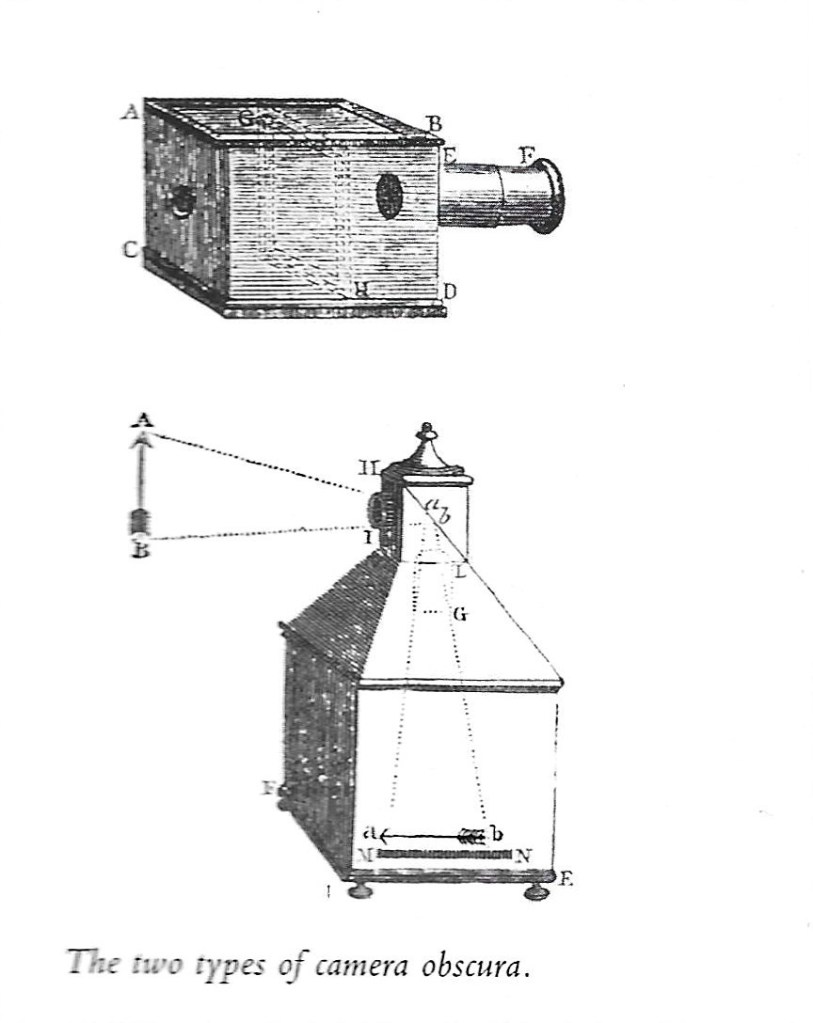
Certain evidence immediately supports such a conclusion. The pinpoint accuracy of some parts of the prospects when viewed from the same spot today, the standard size of the drawings, possibly the size of a drawing screen, and the piecemeal arrangement of elements in some of the prospects.