Pretty well everyone who uses the term “Cornton Vale” these days uses it to refer to the Women’s Prison that existed on the site between 1975 and 2020. This represents only the last 45 years of the name.
Cornton Vale had more than a century of history attached to it before that!

Prior to 1871 the area that we know as Cornton Vale was simply an unnamed group of what appears to be smallholdings.
John Grassom’s map of 1817 shows the development sited on a road which runs from Causewayhead in the East up to Lecropt, by ford, across the Allan Water.
This Ordnance Survey Map of 1861 shows the same area in much more detail: –

It would appear that the smallholdings, if that’s what they were, were tenanted, because in 1871 all of the 34 acres of land was sold to John Thomson, a farmer from Drumtogle near Auchterarder.
34 acres approximates to prettywell everything between the river and the road to Bridge of Allan north of the road where these smallholdings are.
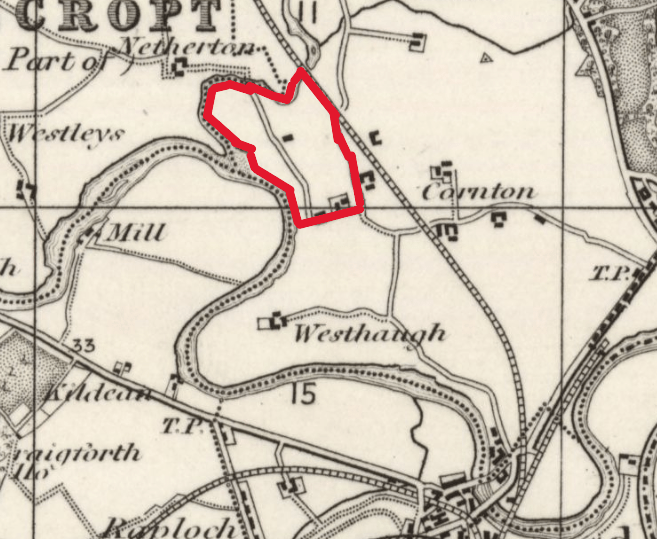
We have no record of exactly where the 34 acres were, but this red line, superimposed upon the 1878 map, approximates to that which quite probably is the area in question considering its subsequent history.
He built a new house and steading on the site. It was he who gave the place its name and it was thereafter to be known as Cornton Vale.
It was generally assumed, because Mr Thomson was a farmer, that he bought the ground specifically for that purpose. However, by this time Bridge of Allan had become a very popular Spa Town and it is entirely possible that John Thomson saw the possibilities that this popularity presented. The photograph of the premises at the head of this page, which seems to represent some sort of advertising postcard, has, hidden away in the bottom left hand corner, the words “Health Resort”. The fact that it also has garnered an association with Bridge of Allan in the depiction of his address seems to add to the notion that here, was an entrepreneur.
John Thompson died at Cornton Vale on 2nd May 1877 aged 85. His wife followed 5 months later. The property passed to his daughter Catherine. She married John Alexander, a Glasgow cement merchant and they owned and lived in the main house until her death on 17th April 1897 aged 61. 1
The 1895 Valuation Roll lists the house and farm as being owned by them and lists the farm as being occupied by “Speedie brothers, Cattle Salesmen, Stirling – partners, John Chapman Speedie and Matthew Speedie.” The whole property seems to have been split up and leased to various ventures because the listing continues to record “Market Garden Cornton Vale”, owned by the Alexanders and leased to “Su’land Bremner, fruiterer, Stirling”. Another House and Garden owned by the Alexanders at the same address has no occupier listed.
From 1897 until 1901 the house at least was occupied by Dr David McCosh, son of John McCosh
This map shows the condition of the area at the end of the 19th Century just before the Church of Scotland bought the site.

Inspired by the training colonies associated with the German Lutheran church, the Church of Scotland bought the 34-acre estate in 1907, with a house, sheds and greenhouses, for the sum of £2,500 with the aim of training “habitual inebriates” as “colonists or as agricultural labourers”.
Operating through its Social Work Department, the Kirk officially opened its new labour colony in September 1907, aiming for an intake of 44 men. Although it continued to accept inebriates, over time the colony increasingly recruited the unemployed; once more, its aim was primarily to remove them from Scotland, and a number were duly shipped out to Canada.
It is recorded that between 1904 and 1913 some 600,000 Scots, 13% of the population, emigrated for North America, the Commonwealth and elsewhere in the UK, taking with them a disproportionate share of Scotland’s skills and education. Between 1921-1931 a further 400,000 Scots leave the country.
In the booklet “A Century of Cornton Vale“, published by The Stirling Smith in 2010, the authors (there were four of them) recall that, at that time, the Church was very choosy about the “inebriates” that they chose to rehabilitate here. They undertook to “…rehabilitate run down men from the cities with a view to emigration to Canada…” BUT “…with a will to do well…”
They would not be including “tramps” and “vagrants”
The booklet describes the general attitudes of the time: –
“At the founding meeting in 1907 the Rev. Menzies Ferguson censured the miners for drunkenness and the Establishment generally blamed the working classes. The working man, in turn, believed that the gentry and aristocracy imbibed even more liberally, but that their habits were better concealed.”
“…The Army requisitioned the site during WW1* and when they gave it up, the new regime was for younger men of 18 – 25 . “Prisoners or Paupers” were not admitted but first offenders or those on probation were taken...”
Initially they were training jobless ex-servicemen while negotiating with the government for funding under the Empire Settlement Act. Some thirty to forty unemployed men were still being trained annually at Cornton Vale when the Empire Settlement scheme came to an end in 1929.
The new minority Labour government continued to fund small scale training for would-be emigrants, but this ceased in 1931. The Kirk, though, supported the colony for a number of years in the hope that improving economic conditions would bring about a return to Dominions emigration, and even extended the accommodation as late as 1938.
In 1938 “The Empire Exhibition” took place in Bellahouston Park in Glasgow. A team of architects oversaw the building of the largest collection of modern architecture in the United Kingdom in the first half of the 20th century. Over 12 million people visited the Exhibition.
Cornton Vale Church Farm was represented in the form of a model in the Church of Scotland Pavillion at that Exhibition. The diorama was extremely well executed and the surviving photograph of it actually gives one the impression of an aerial photograph of the complex itself.

Alongside the display there was a brochure extolling its virtues. Within the brochure the activities at the institution are expanded upon: –
“…Here is the Church Farm. Stirling Castle and the Wallace Monument in the background and the river Forth on the right denote the situation of Cornton Vale. Under a blue sky, harvest has been gathered and ploughing has begun. These well built residents’ quarters accommodate more than 30 men who have been beaten in life’s conflict and have sought the freedom of the open for renewal in body and soul. As the models of the piggery, pens and glass houses indicate, the main pursuits are pig rearing, poultry farming and tomato growing…”
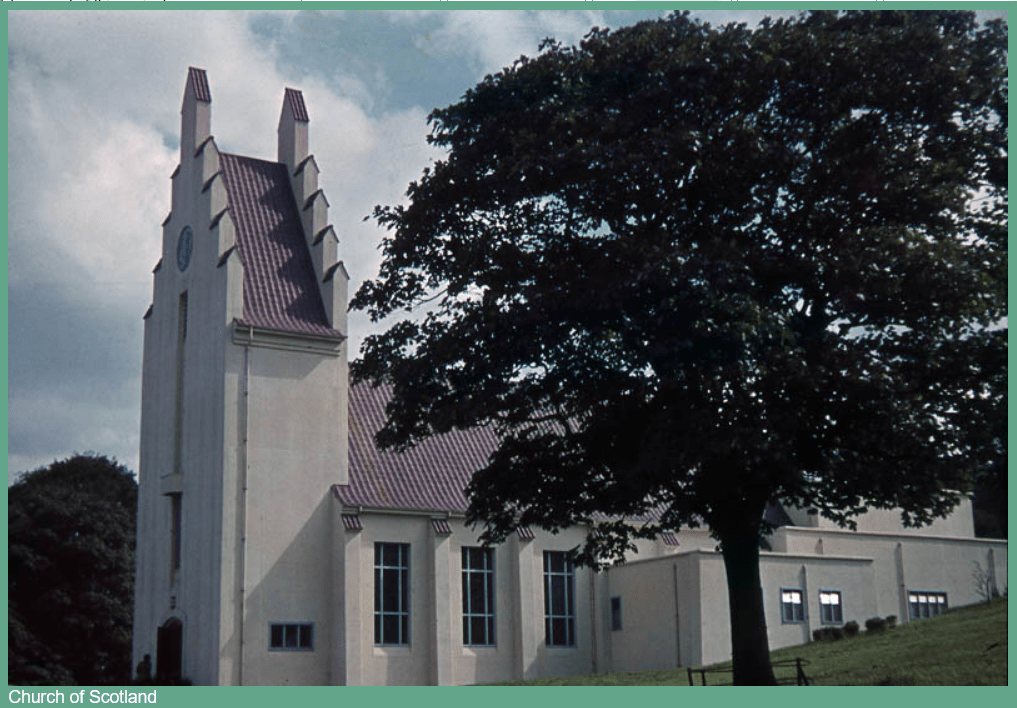
The colony was again taken over by the government during WW2* and in 1946, the Kirk leased and subsequently sold the land to the Scottish Office Prisons Department, for a sum of £3,750. They opened it as a Borstal for young male offenders.
* There are many references to the notion that the Army requisitioned the site during both World Wars but there is no positive record that can be gleaned to that effect (nor to the use to which it may have been put) existing anywhere. The History Group would welcome any corroboration of these claims.
This 1960 Ordnance Survey map shows how the Borstal was laid out. Notably there is what appears to be a block of four flats labelled “Castleview Cottages”. From the appearance of the layout, these flats seem to be of the type commonly built after the 1920’s Housing Acts with Air Raid shelters in the gardens and are likely to have been for staff at the Borstal. Also apparent in this map are the four houses labelled “Cornton Vale Cottages”. These have appeared since the Scottish Office took over the site and will disappear again before the Women’s Prison is built.

It remained as a Borstal until 1975 when it opened as a prison for women which was partly built by the young men serving their Borstal sentence. – “For the Borstal boys, Cornton Vale…gave the boys the experience of useful work in the Community – in Agriculture, Factory and, most valuable of all, in Building Trade settings, with contractors who were otherwise unable to complete the new Women’s Prison on time.” 2
Once the building of the Prison was complete, the young male offenders were phased out and moved to other Borstal or young offender facilities across Scotland. The original Cornton Vale complex was demolished and 10 blocks of four in a block flats were constructed on the site to house the staff at the Prison. Castle Vale, as it was named at the time, is still present today.
There were other prisons in Scotland where women were detained but at that time Cornton Vale would become the locus of the only Prison in Scotland specifically for Women. Details of the Prison can be found here.
So Cornton Vale has had a rich and diverse history. From when it first became known as “Cornton Vale” in 1871 it has been a Farm, a Health Resort, a Market Garden, a Church of Scotland Men’s Colony, a pig rearing and poultry farm, a Borstal & Young Offender’s Institution and, finally, a Women’s Prison.
Sadly the name will now disappear from the records because Castle Vale is built upon the site of the original Cornton Vale House and the prison that continued to bear the name has been rebuilt and renamed “HMP & YOI Stirling”. So this record is quite likely to be the only complete record of the history of “Cornton Vale” from its initial christening in 1871 to its demise some 150 years later.
1 “Cornton and its Portioners”