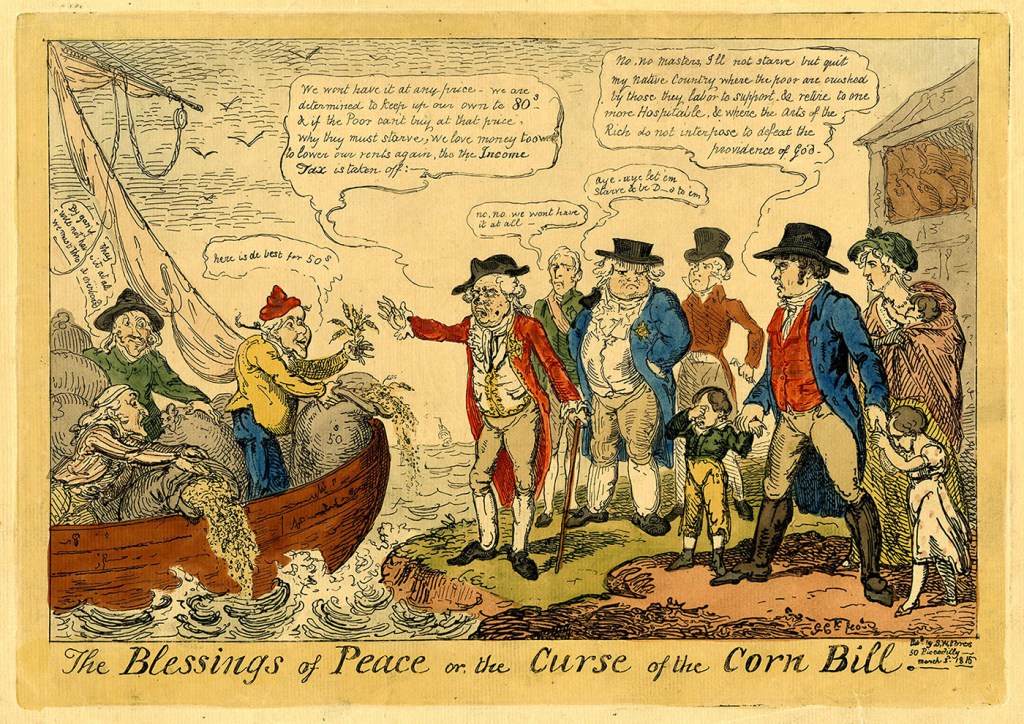
This image from the British Museum is entitled: ‘The Blessings of peace or, the curse of the Corn Bill’. The image shows four landlords who are spurning the three Frenchmen who stand in a small boat. The boat is filled with sacks of corn.
The Frenchmen says: “here is de best for 50s”, (fifty shillings) to which an elderly man replies: “We won’t have it at any price- we are determined to keep up our own to 80s- (eighty shillings) & if the Poor can’t buy at that price, why they must starve, we love money too well to lower our rents again, tho the Income Tax is taken off”. Other Englishmen behind him seem to concur with their companion: “No, no, we won’t have it at all’; “Aye—aye let ’em Starve & be D—d to ’em.” Aghast, one of the Frenchmen empties a sack of corn overboard, declaring: “By gar if they will not have it at all we must thro it over board.” There is another man in the sketch, John Bull, who stands by as the personification of the spirit and morality of the United Kingdom. Accompanied by his wife and children, Bull decries the landlords, saying: “No, No Masters, I’ll not starve but quit My Native Country where the poor are crushed by those they labour to support, & retire to one more Hospitable, & where the Arts of the Rich do not interpose to defeat the providence of God.”
The Corn Laws were passed by the Conservative Prime Minister, Lord Liverpool, in 1815. These were measures brought in by the British government to protect landowners and farmers. They controlled the price of all grain crops, including wheat, barley and oats.
After the Napoleonic Wars, food prices were predicted to fall as Britain resumed its trade with Europe, and goods could once again be imported to Britain. However, further imports of cheaper foreign grain harmed the interests of British landowners and farmers. The Corn Laws were aimed to prevent this harm.
The laws placed tariffs on grain imported from other countries. The price of grain at home had to reach extremely high levels before duty-free grain from overseas was permitted. Harsh import duties made buying grain from abroad unaffordable. Therefore, the Corn Laws made it expensive to import grain, even when domestic grain was in very short supply.
Between 1815 and 1846 the “Corn Laws” restricted the import of food from overseas. “Corn” in that respect included all cereal grains such as wheat, oats and barley. The laws were designed to keep corn prices high to favour domestic farmers by blocking the import of cheap corn.
However these laws enhanced the profits and political power of land owners and did nothing for the lower classes, those who were working the farms, by raising food prices and the cost of living.
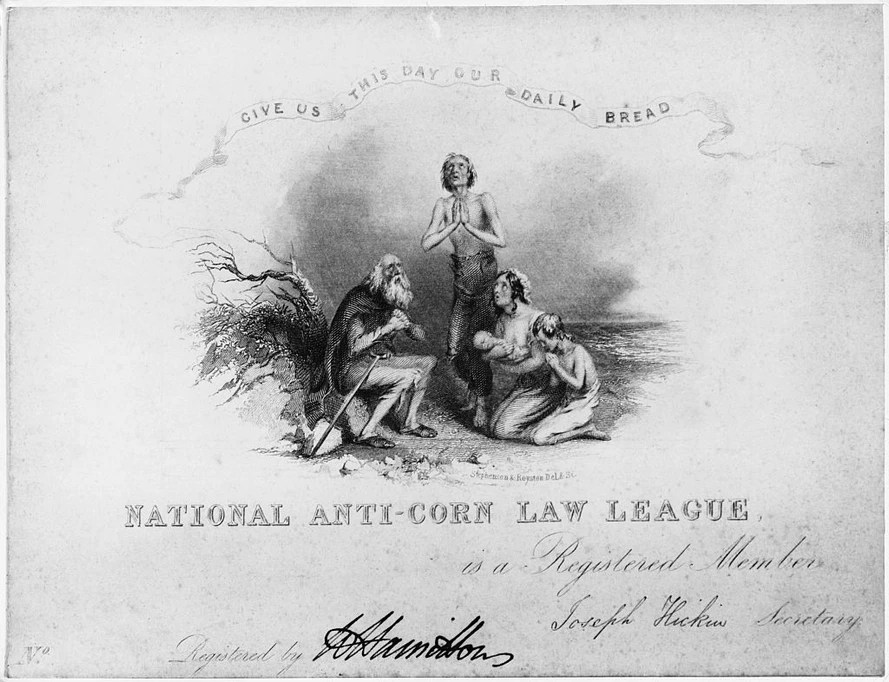
The laws were met by fierce opposition from the public and there were frequent riots against them. The Anti-Corn Law League, founded in 1839, campaigned to repeal the laws. The Corn Laws remained in place until 1846; despite strong opposition from his own political party, Conservative Prime Minister Sir Robert Peel repealed them in 1846.
According to one 2021 study, the repeal of the Corn Laws in benefitted the bottom 90% of income earners in the United Kingdom economically, while causing income losses for the top 10% of income earners.