From the Website of “Old Roads of Scotland”
The Turnpike Era
In the latter half of the 18th century, massive changes in the economy of Scotland led to major improvements in the life of the people. The new enclosures and better farming methods along with the exploitation of mineral resources and the development of industry resulted in a growth of population and better health and living conditions. The Act of Union in 1707 had a crucial part in this as it opened up the large markets of England to Scotland.
Improved roads were an essential part of this revolution, helping to stimulate all aspects of the economy and opening new horizons to people by making travel much easier than before. The system which allowed these new roads to be built was the turnpike system, tolls being levied to meet the considerable cost of building them. To build a turnpike, an Act of Parliament was required and once passed, allowed a trust to be formed which could then arrange for the roads to be built.
Throughout Scotland, hundreds of trusts were formed and a huge programme of road building started which completely revolutionised travel in Scotland. Coaches became more frequent and journeys faster and more comfortable. There were numerous carters and carriers transporting agricultural produce and raw materials like limestone and coal. The New Statistical Account written by Ministers of parishes in the 1830’s speak almost uniformly of the great changes since the previous Statistical Account written in the 1790’s. Even the parish roads had in many cases been improved.
Side by side with the Turnpikes was a new network of roads built in the Highlands by the Parliamentary Commission for Highland Roads and Bridges.
The 1830’s were perhaps the high point of the Turnpike system but it was about that time that railways began to be built. Rail travel was much faster, cheaper and more comfortable and as a result the turnpikes were more and more reduced to taking local traffic and were becoming more uneconomic. The huge debt of the Turnpike trusts, the high tolls which were often unfairly applied with some people paying none on a short journey and others having to pay three or four times for an equivalent journey, and the wide variation on how the commutation money was raised led the government to set up a Commission to assess the situation and see how it could be improved.
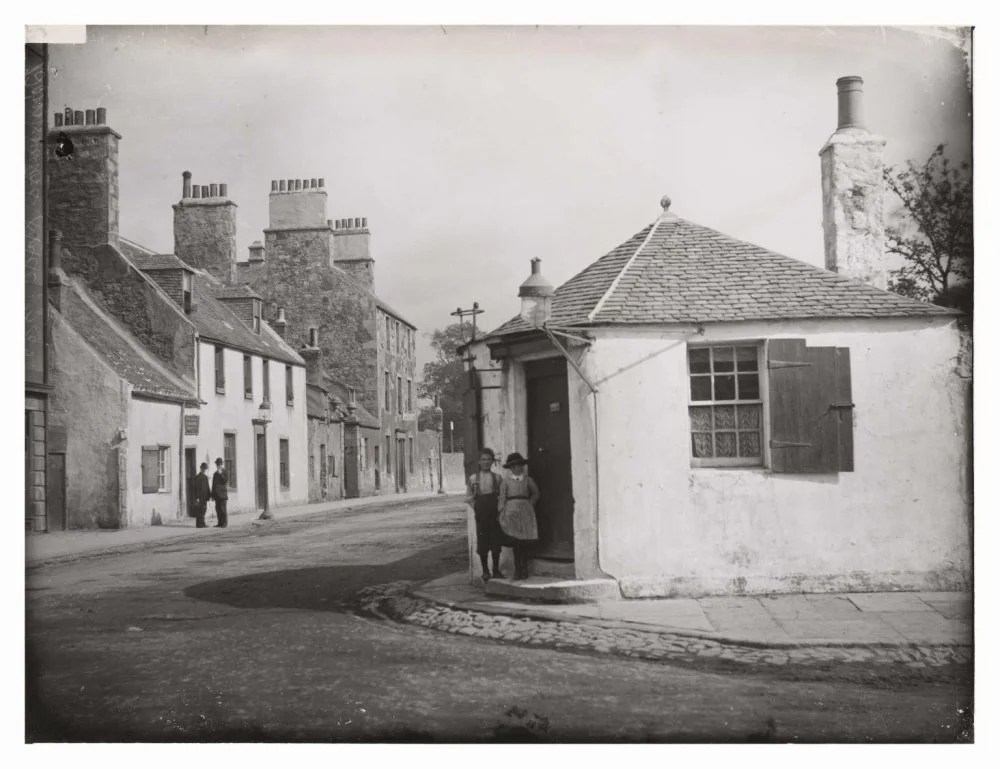
A typical Toll House in Scotland.
Toll houses were usually small but featured distinctive angled bay windows, designed to give the tollkeeper a clear view of the road in both directions. The house was not just a workplace, it was also a family home.
In addition to collecting tolls, tollkeepers were responsible for: –
- Keeping records of tolls collected
- Operating and maintaining the toll gate
- Monitoring for toll evasion
Each Turnpike trust operated under an Act of Parliament, usually for a 21-year period, and could be renewed as needed. Their responsibilities included:
- Surveying and improving roads
- Building toll houses and gates
- Setting toll charges
- Hiring tollkeepers and labourers
Tolls were usually charged based on the number of wheels on a vehicle, the number of animals, or the goods being carried. Pedestrians were often exempt, but drovers, wagons, and commercial travellers were not.
In some areas, toll rights were auctioned to the highest bidder, who paid a fixed amount to the trust and kept any additional profit. This system was widely used. However, it had the potential for abuse.
In its report of 1859, the Commission recommended that Turnpike and statute labour roads should be under the same management in a county and should be funded by a fairer rating system. They also recommended that the Highland Roads and Bridges be placed with their respective counties.
This led eventually to the 1878 Roads & Bridges Act and the Local Government (Scotland) Act of 1889 that re-organised local government. The 1878 Act abolished the Turnpikes and statute labour and Section 11 placed the management and maintenance of highways in counties in a County Road Trust, and in burghs in burgh councils. This continued until 1889, when the County Councils took over roads and bridges.