There is a reference in “Fraser Raitt’s Webspace” to a Military Camp near Cornton Crescent in Bridge of Allan which was demolished in 1922: – “…After the demolition of the Cornton Military Camp in 1922, Council houses were built at Cornton Road and later Cornton Crescent…”
This confuses the issue! One is bound to ask whether there were two “Cornton Military Camp”s or whether “Cornton Military Camp” was not in Cornton at all! As far as we can gather, Bridge of Allan became a Burgh in its own right in 1870. This would mean that at least the following clip referred to the Bridge of Allan Cornton Camp.
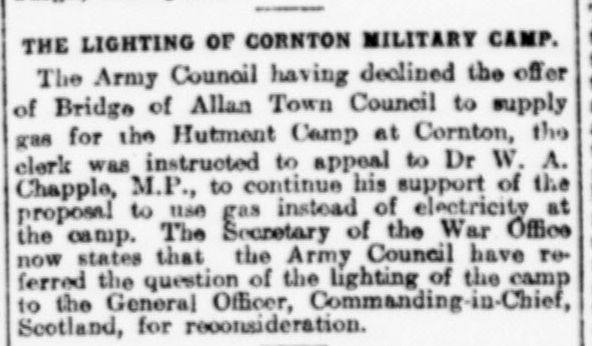
Indeed there is no evidence, that we have so far, to the effect that there was a specific “Military Camp” in Cornton at all except from the reports that during both World Wars the Military requisitioned Cornton Vale. There is of course the possibility that the part of Cornton Vale that was requisitioned during the Wars was an area roughly where the current Prison is situated.
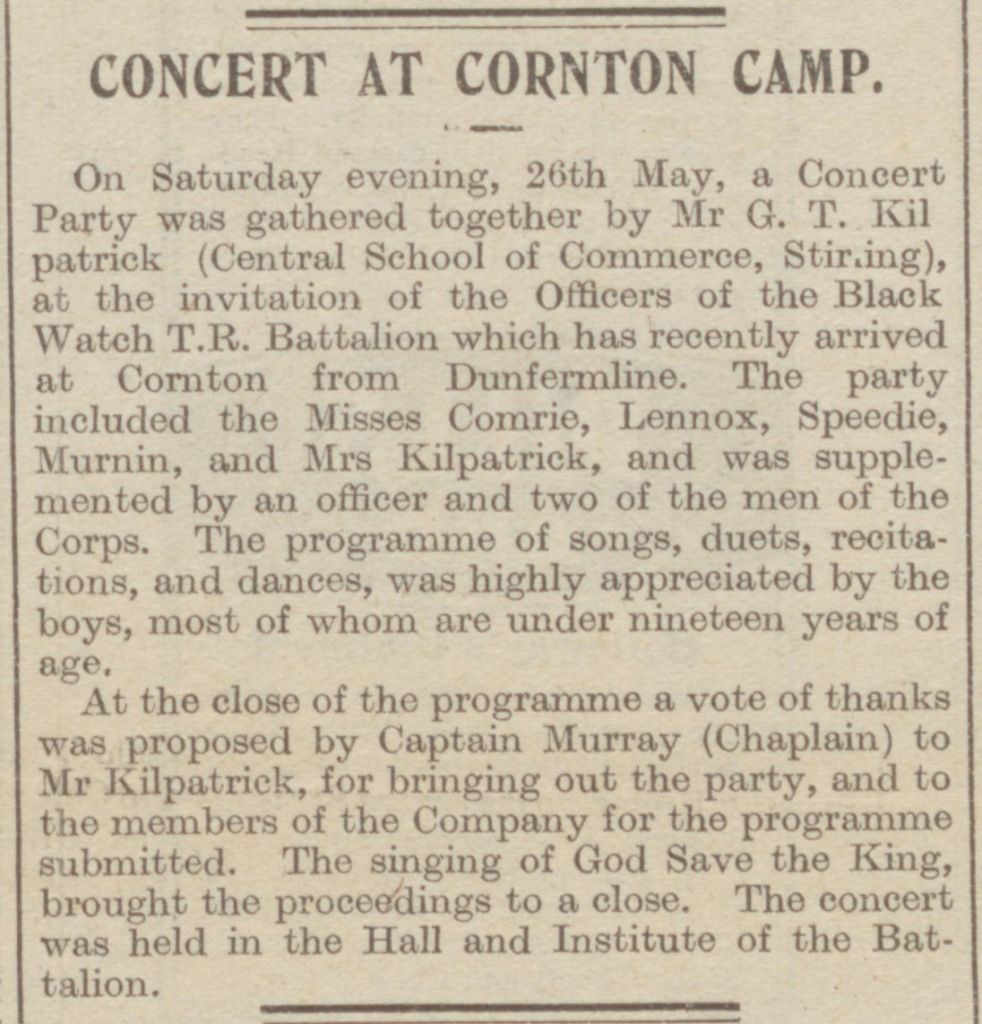
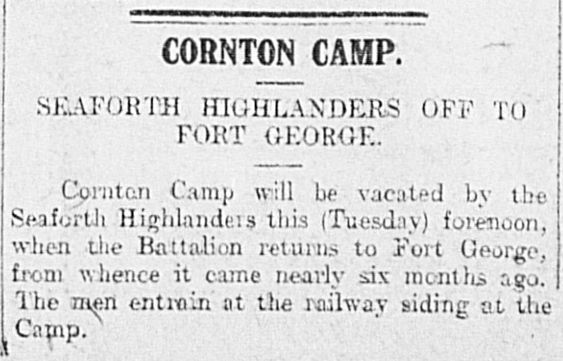
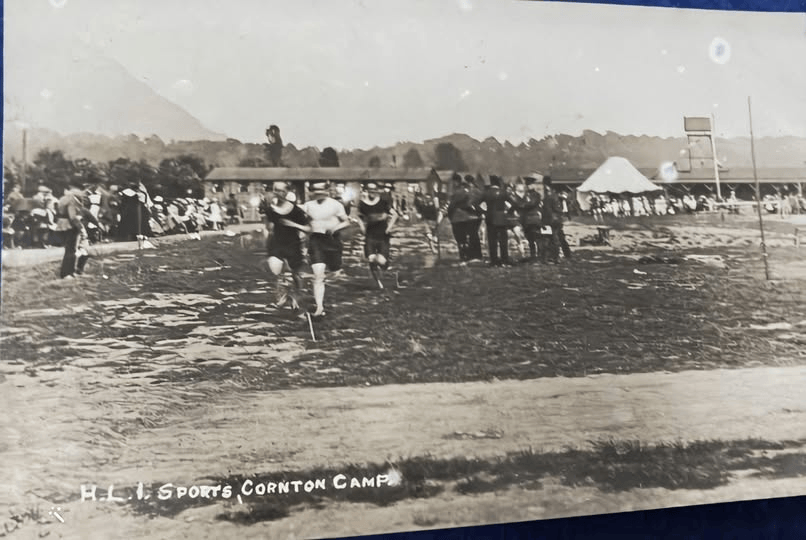
The following information was gleaned as an answer to a query put to A.I. : –
The military requisitioned the Cornton Vale Garden Colony during both World Wars primarily due to its strategic infrastructure, existing accommodation, and established agricultural assets.
Under emergency powers like the Defence of the Realm Act (DORA) in WWI and the Emergency Powers (Defence) Act in WWII, the British government systematically took over pre-existing institutional sites across the country. Cornton Vale was a prime target for the War Office for several specific reasons: [1]
1. Existing Infrastructure and Housing
Setting up a new military camp from scratch required a massive amount of lumber, labor, and time. Cornton Vale already featured fully built dormitories, communal dining halls, and administrative offices that the Church of Scotland had built to house its “colonists”. The military could immediately march troops or personnel into the estate and utilize the ready-made barracks-style setup. [1]
2. The Railway Corridors
The estate sat directly adjacent to the vital Caledonian Railway line. During both world wars, Stirling was a crucial transport hub connecting the industrial hubs of central Scotland to the Highlands and the naval bases further north (such as Invergordon and Scapa Flow). Having a secure, fully built compound right along a major rail artery was highly advantageous for troop transit, logistics, or securing local infrastructure.
3. Food Production and Agricultural Assets
Cornton Vale was an active market gardening and farming estate equipped with extensive greenhouses, sheds, and cultivated land.
- During World War I, and even more aggressively during World War II, the UK faced severe food shortages due to enemy blockades.
- Requisitioning an already highly productive agricultural facility allowed the state to guarantee food supply chains for nearby military garrisons (such as Stirling Castle or the nearby standard transit camps).
Post-War Handbacks
The transitions after both wars highlight how the site was used:
- After WWI: The army handed the site back to the Church of Scotland, which immediately repurposed it to provide agricultural training for unemployed, jobless ex-servicemen trying to reintegrate into civilian life.
- After WWII: The government took over the site permanently. Recognising that the camp-style layout was perfect for secure but open-air governance, they officially bought the land from the Kirk to open it as a male Borstal in 1946.

