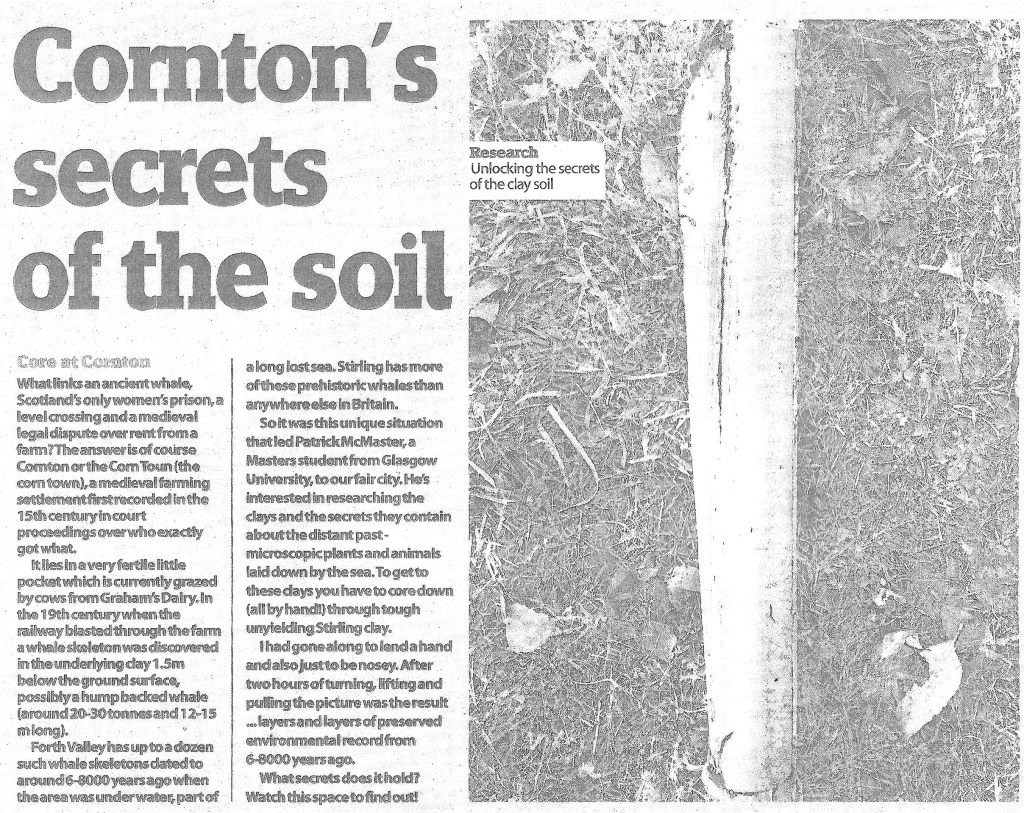
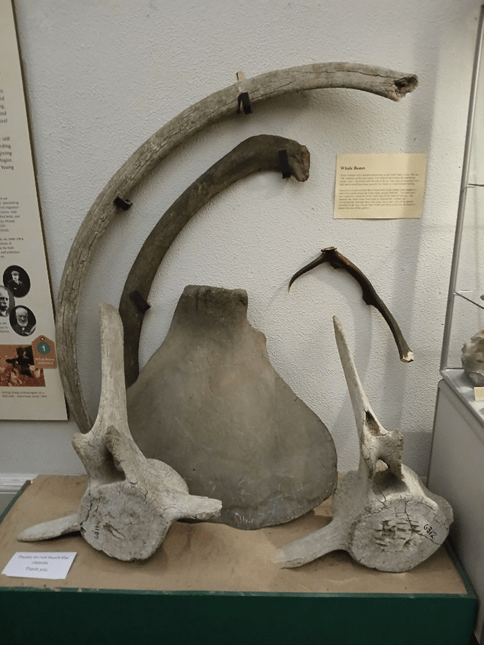
Whale remains were common discoveries in the Forth Valley in the 18th and 19th centuries as moss lands were cleared uncovering the underlying estuary clays. Sea levels after the end of the Ice Age on occasions were high and it would have been possible for whales to reach beyond Stirling. However it is also possible that at least some of the whales were caught in a tidal wave which struck the Forth Valley around 5000 BC. The tidal wave was caused by a landslide in the North Sea off the coast of Norway. The Smith Institute museum has Whale bones from finds at Gargunnock, Cornton and Causewayhead although there were many more sites. One of the species identified at the time was the blue whale likely to be over 30 metres in length.
Transcript of notes accompanying the display (see photograph) at the Smith Institute Museum.
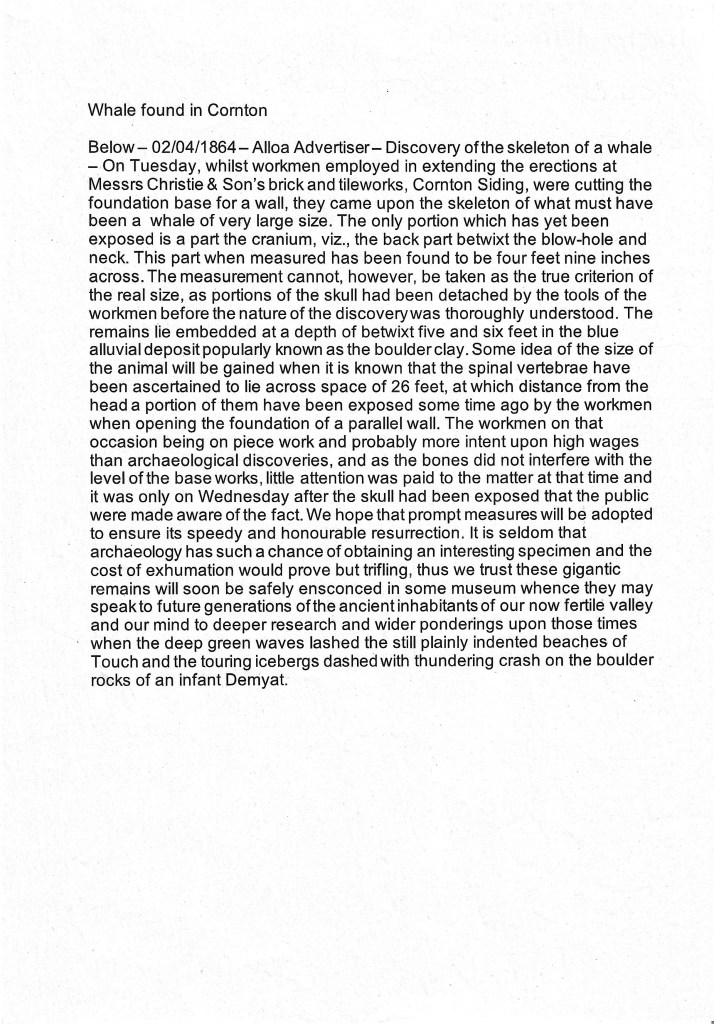
The notion that these things are more common than one might think is borne out by the following extract from the New Statistical Account of Scotland : –
…The most remarkable animal remain found in this Parish, in this deposit, was the entire skeleton of a whale, which, according to the measurements which were made, must have been fully seventy feet long. It was found in the year 1819, in the course of some draining operations carrying on by the late Sir Robert Abercromby in the estate of Airthrey. The place where it was found was adjoining the south side of the turnpike-road east from the eastern porter’s lodge, which leads to Airthrey Castle, and near to the north verge of the alluvial deposit of the River Forth.
The bones were, in general, hard and undecayed, and lay in regular connected order from the head to the tail. They were imbedded in the blue silt immediately under the stiff clay. It was found, from very accurate levels taken, that this skeleton lay twenty-two feet higher than the pitch of the present highest stream-tides of the River Forth, immediately opposite. From which circumstance there is reason to conclude, that the highest tides of the River Forth are, in this district, at least twenty-six feet lower than they were at the time when the whale was stranded; and it is evident that this must have been many centuries before the Romans invaded this country, as there was till lately upon the side of the Forth, near the farmhouse of the manor, a Roman fort,—and the Manor Ford, which had been connected with the fort, and formed of loose stones, remains to the present day. These circumstances prove, that the Forth has not changed its course in this immediate district for an immense period of years.
Sir Robert Abercromby was at all due pains to have the bones very carefully dug up, and carried to a safe place in his court of offices ; and then, in the most liberal and polite manner, presented the whole to the museum of the Edinburgh University. The immense canine- bone and ribs, and a few of the vertebrae, are to be seen at the head of the lower room of the museum. It is remarkable that one of the ribs had been broken and knit again, as the bone is much thicker at that place.
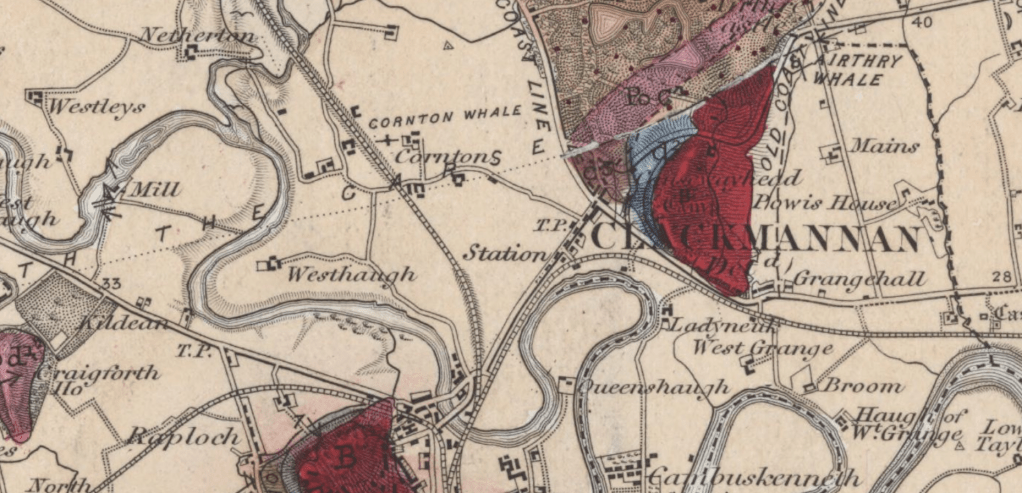
This O. S. Map of 1882 shows the sites of the finds of both the Cornton and Airthrey Whales: –