The soils of the Carse are naturally rich in fine clay particles and are called ‘heavy soils’, although hard to manage, they are also potentially very fertile when treated in the right way. The practice of adding Lime to the soil began in the 18th Century and very quickly became a widespread practice. There are many benefits to spreading lime on farm. Lime is a soil conditioner and controls the soil acidity by neutralising the effects of acids from nitrogen (N) fertiliser, slurry and high rainfall. Other benefits include an increase in earthworm activity, improvement in soil structure and grass is more palatable to livestock.
Historically, liming of farm fields in centuries past was often done with burnt lime. The difference is at least partially explained by the fact that affordable mass-production-scale fine milling of stone and ore relies on technologies developed since the mid-19th century.
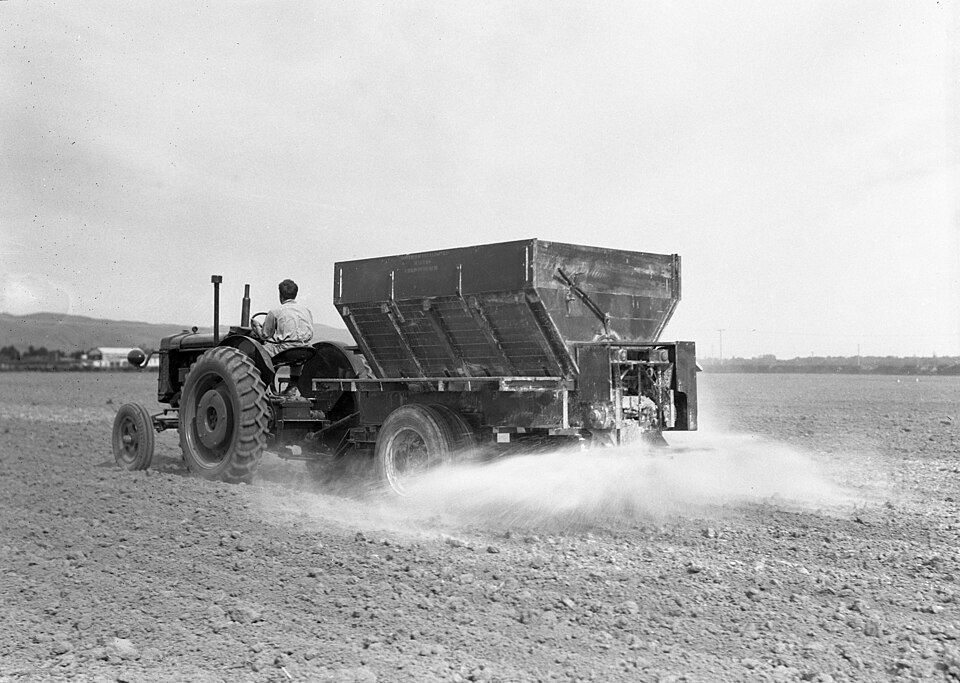
Picture shows bulk lime spreader in action, 8 September 1949.
Until the beginnings of the industrial revolution lime had been used as a building product, consisting , as it does, of calcium Carbonate. Until then, as a result lime production was confined to intermittent vernacular kilns or at the foot of large buildings under construction (churches, castles, fortifications, etc.). Hydraulic limes (of varying degrees) or airlimes were then described as lean or fat lime, without fully understanding the difference between them. It was only with the development of technology that lime began to specialise. The needs of steel production and the chemical industry would lead to the search for deposits with the lowest water content in favour of the aerial part. Infrastructure (bridges, engineering structures, etc.) and maritime construction (ports, lighthouses, etc.) needs led to research into the hydraulic properties of lime.