Brigend – The house, the subject of Katherine Steuart’s book “By Allan Water”, which existed beside the original bridge over the Allan Water in the area of Bridge of Allan.
Borstal – The word “Borstal” has its origins in the name of the Kentish Village, now absorbed into Rochester. It is shorthand for an establishment catering for young men aged between 16 and 21 committed by the Courts. The first of these institutions was established in a disused prison in Borstal in 1902 in answer to the concerns that the youths of that age group were “…sent to adult prisons and thrown together with the worst of older criminals, where contamination rather than education was the order of the day…” The treatment of the boys at Borstal Institutions at their initiation was not ideal. Cold baths and corporal punishment were the order of the day until the 1940s. At that time these practices were largely discontinued after a distinguished Home Office Commissioner, Sir Alexander Paterson, expressed strong disapproval with the words – “A boy is sent to Borstal as a punishment – not for punishment!”
Carse – low fertile land usually along a river. Same as Haugh although Haugh is more localised.
Changekeeper – A Pub Landlord from the archaic “Change” meaning Pub.
Contemporary – Existing or happening at the same time. Never – modern!
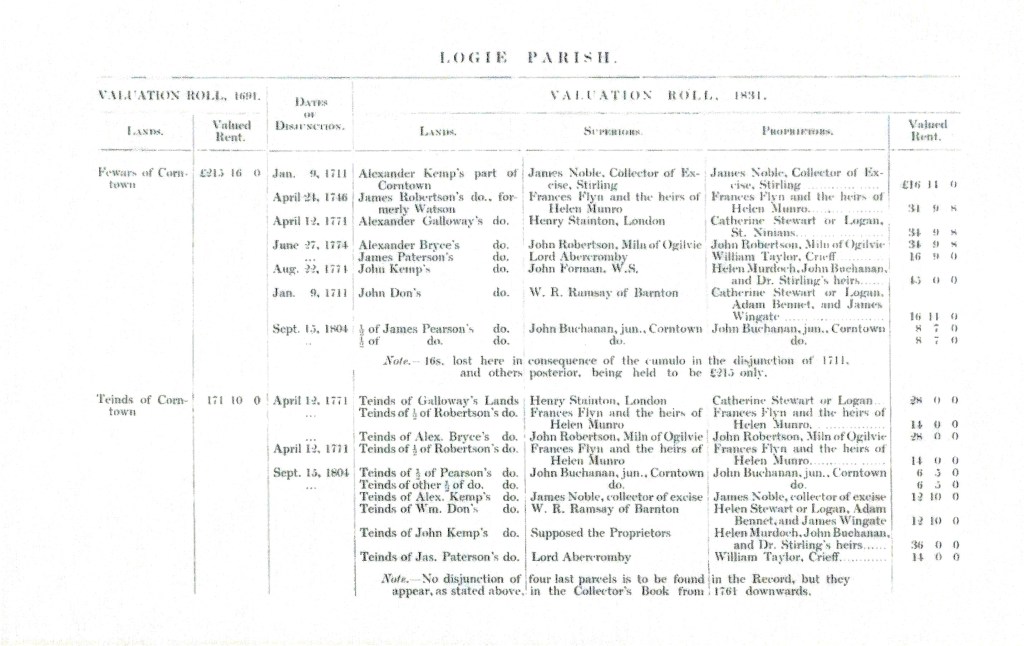
Portioner – Scots law : the owner of a portion of a decedent’s estate : a small laird. This copy of the 1831 Valuation roll indicates how the lands of Cornton would have been distributed: –
Rotherham Plough – patented it in November 1730,
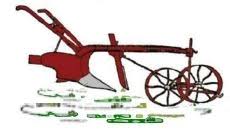
Commonly known as the Rotherham Plough, although not the first iron plough, was the first to achieve commercial success due to its innovative design and lighter weight. It remained in use in Britain until tractors were developed.
Run rig, or runrig – also known as rig-a-rendal, was a system of land tenure practised in Scotland, particularly in the Highlands and Islands. It was used on open fields for arable farming. Each area was divided into long strips of land known as Rigs. It was often the case that rather than tenant one whole field a farmer would rather work a series of rigs in different areas. Its origins are not clear, but it is possible that the practice was adopted in the late medieval period, supplanting earlier enclosed fields which were associated with a more dispersed pattern of settlement. It fell into decline mainly over the last quarter of the 18th century and the first quarter of the 19th century.