HMP & YOI Stirling
(His Majesty’s Prison and Young Offender’s Institution)
The lands of Cornton Vale were sold by John Christie in 1871 to John Thomson, a farmer from Drumtogle near Auchterarder. He built a new farmhouse and steading on the site, and it was he who christened the place as “Cornton Vale” at that time. When he died in 1877 the property passed to his daughter Catherine. She married John Alexander, a Glasgow cement merchant and they lived in the house until his death in 1897. From then until 1901 it was occupied by Dr David McCosh, son of John McCosh.1
Before 1939, the site belonged to a Church of Scotland labour colony (common until the Second World War). Opened in 1907, the colony provided a home and training in market gardening for “habitual inebriates” and others – all male – sent by the Church or by their families. After the First World War, it took in unemployed men, mainly veterans at first. From 1926 to 1931, it received public funds under the Empire Settlement Act 1922, and most of the trainees were helped to emigrate to the Dominions. It continued to train unemployed young men until the Second World War, but was sold off subsequently to the Scottish Office and re-opened as a male Borstal in 1946.
“For the Borstal boys, Cornton Vale…gave the boys the experience of usefull work in the Community – in Agriculture, Factory and, most valuable of all, in Building Trade settings, with contractors who were otherwise unable to complete the new Women’s Prison on time.”2
In 1975 the site was redeveloped as a purpose-built female prison. The layout was unconventional with a series of bungalows forming the basic concept, each with one warden and seven prisoners in individual rooms.
Castle Vale was built at the same time, as accommodation for the the Prison Officers. It consisted of 10 blocks of two storey flats, each block containing four flats. Along with that development there was a Social Club which later became the locus of a Training Unit for the prisoners where they would be trained in hairdressing.
Sheena Dorrington recalls: –
“Every Tuesday the Pensioners went over to the Prison and got their hair done.”
Along with the Prison itself, in addition to the flats at Castle Vale, there was built a series of dwellings for the staff. These were known as Cornton Vale Cottages and were subsequently utilised as “Independent Living Units”. These were outside the Prison. There were six Units and they housed prisoners who were nearing the end of their sentence and were preparing for release.
In the booklet “A Century of Cornton Vale” published by Stirling Smith in 2010 the authors say: –
“In recent years, the establishment of Independent Living Units, in effect Cornton Vale’s own Open Prison, has enabled suitable risk assessed women to access work and education places to help them with the transition between prison and Community.”
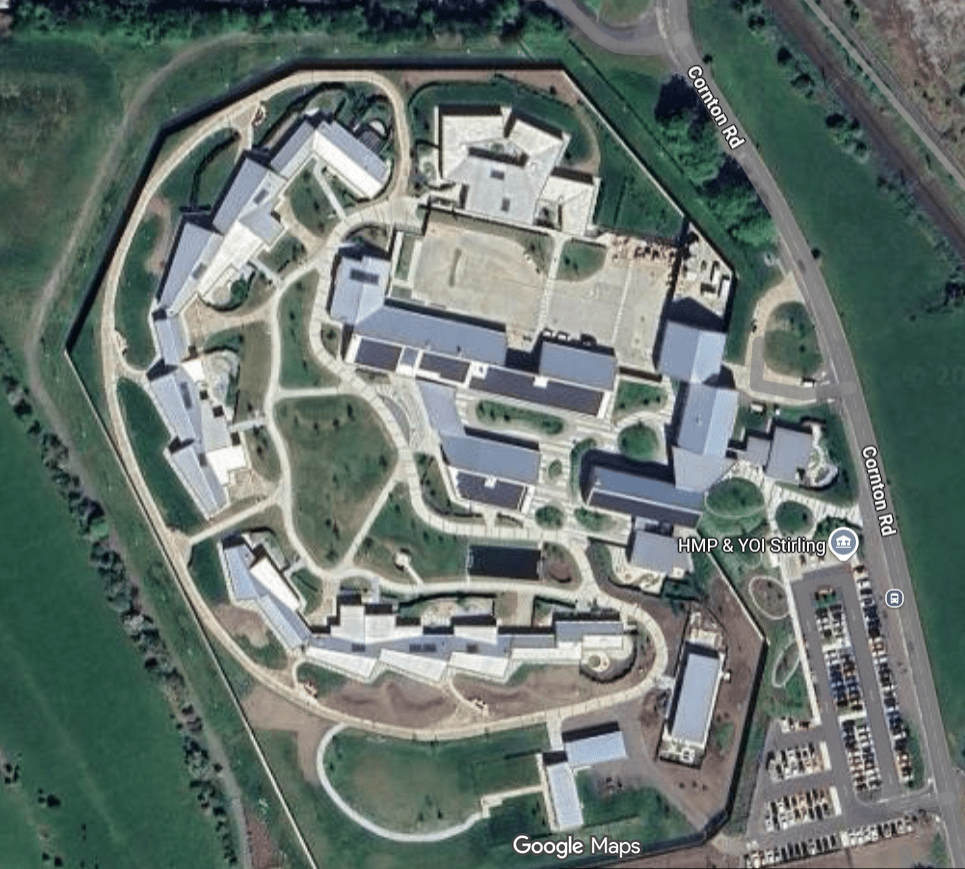
Cornton Vale Prison was closed in the early 2020s to be replaced by a new facility which was completed in 2023.
It is now a state of the art facility for the Scottish Prison Service for Women in custody in Scotland, and replaces the previous HMP Cornton Vale. The design pioneers a therapeutic approach to prisoner care with wellbeing and rehabilitation at its heart. The facility provides places for 100 Women, with a wide range of support, education, and wellbeing facilities.
The design has received a number of awards: –
GIA Awards 2023 – Healthcare Award
Scottish Design Awards 2024 – Health Building Award
Stirling Society of Architects Awards 2024 – SSA Award
Stirling Society of Architects Awards 2024 – Overall Chapter Award
RIAS Awards 2025 – Winner
RIAS Awards 2025 – Design Innovation Award
RIBA National Awards 2025 – Winner
(RIAS – Royal Incorporation of Architects Scotland. RIBA – Royal Institute of British Architects. GIA Glasgow Institute of Architects.)
The complex has a state of the art medical facility of which Cathie Cowan, Chief Executive of NHS Forth Valley, said: “The healthcare centre we have developed within this new prison will enable us to provide a wide range of treatment and support to women in a modern, purpose-built facility. These include general health and dental services as well as specialist mental health and psychological support for women with more complex healthcare needs or drug and alcohol addictions. We have recruited an experienced team of nurses, therapists, dentists, medical staff and healthcare support workers who will be based within the new healthcare centre and they are looking forward to working closely with prison staff and women to deliver high-quality healthcare and services.”
HMP & YOI Governors from 1975: –
1975-1983 – Lady Martha V. Bruce OBE TD
1983-1983 – W. G. Walker
1983-1985 – W. T. Finlayson
1985-1989 – J. D. Meiklejohn
1989-1991 – A. Thompson
1991-1994 – P. L. Abernethy
1994-1996 – R. R. H. Glen
1996-2001 – Kate Donegan
2001-2002 – Stephen Swan
2002-2006 – Sue Brookes
2006-2009 – Ian D. F. Gunn
2009 – Teresa Medhurst.
2009-2026 – to be confirmed
2026- Paula Arnold
1 – John McCosh was an army surgeon who took documentary photographs while Serving in India and Burma. His photographs during the second Anglo Sikh war 1948 to 1849 of people and places associated with the British rule in India (for which he is best known) and of the second Anglo Burmese war 1852 to 1853 count as sufficient grounds to recognise him as the first war photographer to be known by name.
2 – A Century of Cornton Vale.