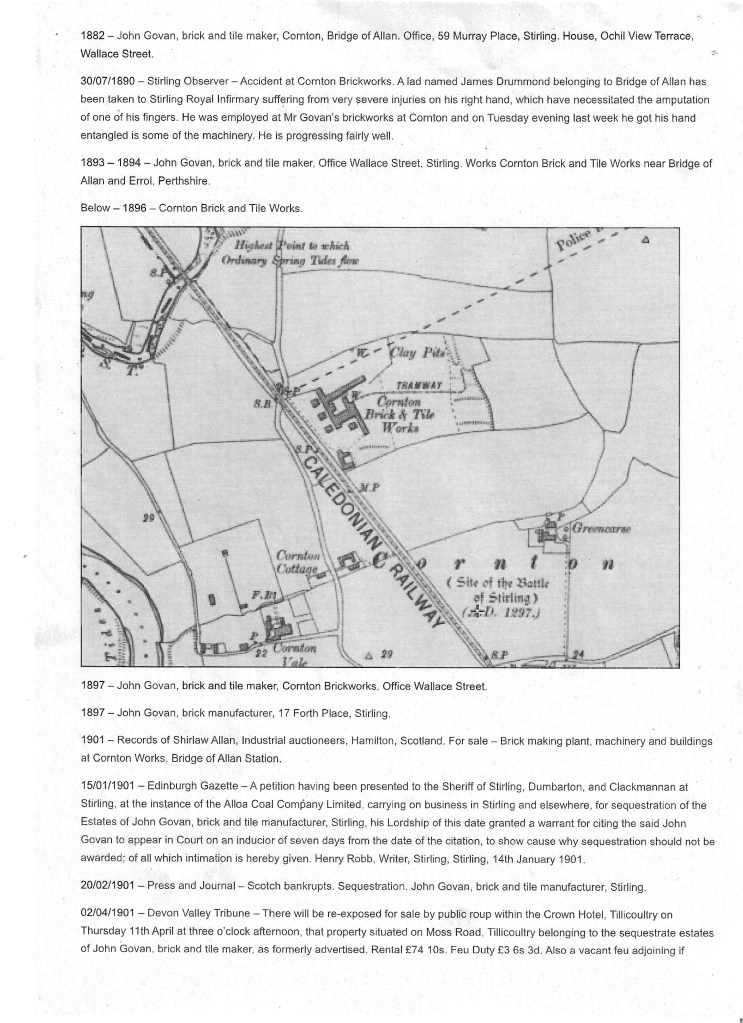
Cornton Brick and Tile Works, strictly speaking are not in today’s Cornton, being on the other side of the railway but they are central to the subsequent development of Cornton.
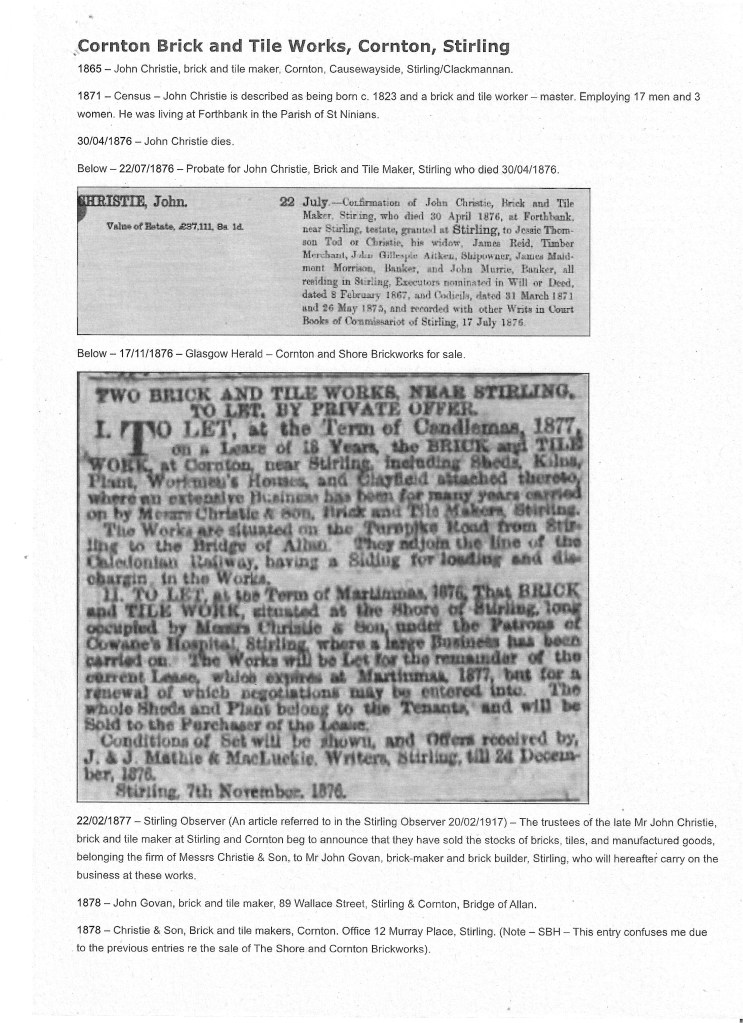
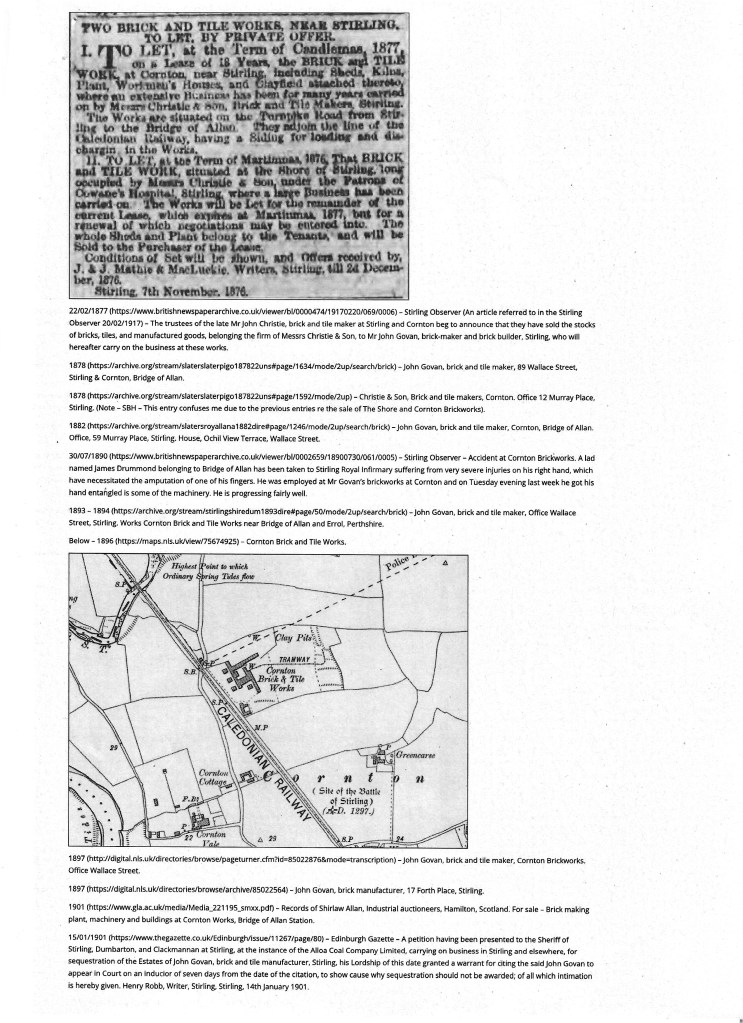
George Christie and his son, John Christie, were brick and tile manufacturers. They were based at Shore Road, Stirling, and also occupied the brick and tile works at Cornton. Another site was based in Perth and erected in 1857. John carried on the business after his father, George, died in 1867. It is recorded in “The Portioners of Cornton” (p228) that “…a twelfth part of the lands of Cornton was sold in July 1862… by the Rev. James Noble Bennie, vicar of St Mary’s Leicester.. in favour of John Christie, brick and tile maker, Stirling dated November 1862…” It goes on to say that he also purchased the lands of Forthbank. He then went on to make a settlement in favour of his wife, and others as trustees. He died in 1876 and the lands were held by the trustees who sold them in 1899: –
1 – Field next to and on the east side of the Caledonian Railway extending to 21 acres – Bridge of Allan Gaslight Company
2 – Field Field on the banks of the River Allan extending to 9 Acres – John McLaren Frase Livestock Salesman Perth
3 – Field extending to 4 acres on the old road at Cornton Vale- John Alexander
The low-lying carse land of Cornton was ideal for the extraction of clay and “Cornton Brick and Tile”, headed up by George Christie, acquired the rights to extract clay and build kilns by securing long-term mineral and agricultural leases from Cowane’s Hospital Trust. Because the ground was full of heavy, carse clay, it was agriculturally difficult until George Christie turned it into a massive extraction site. His business model was highly advantageous to the local lords: he extracted the raw clay to make drainage tiles, and the landowners used those exact tiles to drain the rest of their agricultural estates.
Because George Christie eventually became a prominent Stirling Town Councillor, his business dealings were heavily intertwined with this specific civic trust.
As the business exploded in scale—with the patriarch, George Christie, eventually employing nearly 100 workers by the 1860s—the family used their profits to systematically buy out the titles to their leased lands. This converted their temporary clay-extraction fields into permanent corporate assets.
By the time George Christie died in 1867, these piecemeal leases had successfully been consolidated into a vast, privately owned land portfolio. This was the exact portfolio his son John inherited and eventually divided, selling the 34-acre slice of Cornton to John Thompson in 1871, a farmer from Auchterarder. This was the land, the centre of which Thompson would christen Cornton Vale. The sale was part of the restructuring of the Christie family’s extensive property and industrial holdings in Stirling, which John fully inherited after his father George’s death in 1867.
In 1871 census John was noted to have employed 17 men and 3 women. John died in 1876. The stocks of bricks and tiles were sold to Mr John Govan, brick-maker and brick builder, Stirling, who carried on the business at the works at Shore Road and Cornton.
In 1895 The valuation Roll lists the Proprietors of “Brickwork, Cornton, Bridge of Allan ” as Trustees of the late John Christie of Forthbank, Stirling, per Mathie, McLuckie & Lupton, Solicitors, Stirling. The Tenant of the premises is listed as John Govan, brickmaker. Curiously the same John Govan is listed as tenant of four houses at the same address.
The works existed there until 1899 when the site became Bridge of Allan Town Council Gas Works and subsequently Cornton Ironfoundry.